
Kathleen Norris in her essay on preaching says that one of the best parts of what is often a difficult task is the opportunity to delve deeply into the text. Each time she reads and studies the text on which she is preaching, she learns more – she sinks deeper into the word of God. Sermon preparation can be wonderfully fascinating as individual words and the whole text are studied and questions arise. Each time we read or hear the word of God, we are given a chance to think about God and our world and our role in this world. Questions ought to bubble up, including: why is this here; what did this text mean then; and what does it mean today.
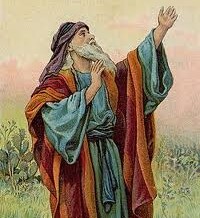
Moses is near the end of his time with the Israelites. He knows that he will not enter the Promised Land with them. His role was to take the people out of slavery in Egypt, through the wilderness where the people began to cohere into a community that worshipped one God, and to the next point of their lives together as a people. Moses has served as the intermediary for the people throughout this time. He has been a prophet in the sense that God has communicated with Moses and Moses has relayed those conversations to the people. The people had earlier decided that they were not strong enough to speak with God directly and had asked Moses to fill the role of intermediary. Moses is a prophet in the best sense of the word.
In Hebrew, one of the words used in connection with a prophet is “nabi” which means “to bubble forth.”[1] The Word of God spoken to Moses bubbled forth from him to the people. The people’s response was to listen and to respond. It reminds us of Jesus’ saying “those with ears, listen” which often was the closing line of a parable.
One writer puts the role of prophet as follows: “the great task assigned to the prophets whom God raised up among the people was ‘to correct moral and religious abuses, to proclaim the great moral and religious truths which are connected with the character of God, and which lie at the foundation of his government.’ The whole Word of God may in this general sense be spoken of as prophetic, inasmuch as it was written by men who received the revelation they communicated from God, no matter what its nature might be. The foretelling of future events was not a necessary but only an incidental part of the prophetic office.”[2]
The Jewish faith views prophecy not as a gift that is arbitrarily conferred upon people but rather as the culmination of a person’s spiritual and ethical development. Likewise, the prophetic gift leaves a person if that person acts in ways contrary to their spiritual and ethical teachings or knowledge.[3] Abraham Joshua Heschel, one of the great writers and thinkers of the 20th century said that prophets are characterized by theotropism – God turning towards humanity”.[4] Think of the Sistine Chapel’s ceiling with its famous fresco of God reaching out towards Adam. God reaching out to us – then and now. So, prophets old and today are persons raised up from their own community who: (a) know the community’s mores and needs, and (b) who can see where their own community has gone astray and call that community back to right relationship with God. In many ways, our Search Committee is our very own Prophet- a committee raised up out of this community who knows us and is discerning what we need to remain in right relationship with God and who is seeking a rector who will help us live into that relationship in ways that are healthy and fruitful.
There is a downside to being a false prophet, though. God tells Moses, and Moses tells the people: those who prophesy falsely shall die. Beware, then, when prophesying that what you are saying is consistent with what you know about God. This is not a time to be saying things to guild your own pocket – for your own advancement. This is not always about the future- and indeed today we probably don’t listen very well to those who foretell the future. Indeed, we look with skepticism and sorrow as so-called prophets who led their followers to death and destruction. Think about Jim Jones and those who drank the poisoned kool-aid. Or David Koresh and Branch Davidian. We have plenty examples of so-called prophets-gone-wrong where they and others suffer death or destruction.
And, we have examples of those who are true to the God we know, in so far as we can ever know God. For me, I have only to think about Martin Luther King, Jr. who called us all to a better world where one day little Black boys and girls could play with little white boys and girls. We have not reached the fullness of his vision, but we are moving in the direction he called us to. To be a prophet does not mean you are other than human, and with being human come flaws. To call someone a modern day prophet does not elevate them to divinity. Rather, to call someone a modern day prophet means that, as far as I can tell, that person is calling me to account for where I have strayed from the vision of God. To call me to account for those instances where I have been less than just or less than merciful.
Moses has been a faithful prophet to the people of Israel. But he knows that his time in this role is passing away. He is preparing the people for their new life in the Promised Land by warning them to be aware of new prophets. To think for themselves, to analyze and ponder what a new prophet says. To ask the hard questions: is what this person entreating me to be and to do consistent with what I know about God and God’s desire for humankind. This is not about whether we will prosper- whether we will always have a good job and health and our families grow strong in. A prophet is sometimes- but infrequently- about the future. A prophet is about calling us to account for today’s actions and beliefs so that we might be righteous before the Lord.
Do not be afraid to speak out. Do not be afraid when others speak to you. Prophecy can be hard to hear when we have gone astray. But the benefits of metanoia- of turning around, of repentance for actions that have taken us from God- are worth everything. Come to me all you that are heavy laden and I will give you rest. The finger and the hand of God are outstretched – God is waiting for us to listen to true prophets. To respond to the call to live with justice and mercy towards all.
[1] http://www.christiananswers.net/dictionary/prophet.html (January 27, 2012)
[2] Id
[3]http://www.jewfaq.org/index.htm (January 28, 2012)
[4] Abraham Joshua Heschel. The Prophets (New York, Harper & Row, 1962).