
Victor can’t see and he can’t walk. But he had a dream. To be an acolyte at his parish in the Diocese of Atlanta.[1]
“I’m so sorry, but you can’t see and you can’t walk, so you can’t be an acolyte.” A knee-jerk reaction that too often is “we can’t do that” or “we’ve never done it that way.” It’s comfortable to do things the way we have always done them. It’s safer to do things the way we were taught- we don’t have to think. We don’t have to stretch. We don’t have to trust God to show us a new way.
The prophet Isaiah chides us: “Have you not seen? Have you not heard? Has it not been told you from the beginning? (Is. 40:21). God is not stopped even if we are blind and even if we can’t walk. Even when all appears lost and we are in despair, God is present and can do wonderous things. Imagine, for a moment, that you are expecting guests for dinner and you take sick. There’s no time for you to call and tell your son, “Simon, go to John’s house. I’m too sick to prepare the dinner.” The guests are already here and you’re stuck in bed, too sick to even get up and go downstairs to greet them.
Jesus, the stranger for all we know to Simon and Andrew’s mother, comes to her bedside and raises her up. How many of us would let someone we don’t know into our bedroom when we are sick? The embarrassment and shame of not being able to do our part to welcome our son’s friends must have been great. But Jesus comes in anyway. Don’t you just hear the mother (or yourself), “oh, I’ll be fine; you just go ahead and have dinner. Don’t worry about me.” Jesus ignores her and goes straightaway to her bedside. And he raises her up. And she then goes to serve them. She is restored to her place in the family and as host.
It would have been easy to say “I’m so sorry, but you’re sick so you can’t host this dinner.” But that’s not what Jesus is willing to hear or to let happen. Jesus goes to where there is need and he raises her up. She is restored to health and to her role as mother of two of the disciples.
One of the ways in which we can live out the gospel is to look beyond the norm – to look beyond the initial and often automatic knee-jerk “so sorry, but we’ve never done it that way” (with the unsaid: “and we’re not going to change for you”).
So often in the gospels we read about Jesus’ healing ministry. He heals the sick, the lame, the blind and the ones possessed by demons. Healing is good- but it’s not all the Jesus accomplishes with his touch or with his words. He heals in mind as well as in body. He restores people to independence and to their place in their family and their society. He looks for ways to say “yes” rather than “no.” He is willing to take a chance to give someone life.
Victor is blind and Victor can’t walk. But Victor is a faithful member of his parish who wanted to serve. Who wanted to be an acolyte- a person who carries the cross or the torch, who serves at the altar, who is recognized in a role that is important in our worship. Victor wanted a chance to glorify God despite his physical limitations. Fortunately for Victor, the acolyte master saw possibility where others might not have taken the time – or had the love and the faith in God – to look for what Victor could do rather than focusing on what he could not do. Fortunately for Victor, the rector, too, was willing to look into what might be rather than be constrained by what had always been done.
“Have you not known? Have you not heard?” Isaiah reminds the Israelites captive in Babylon that God is present even in the darkest times. God is transcendent – above all the earth and who can make the rulers as nothing. God is immament – or close by us and here and now, “giving power to the faint and strength to the powerless” (Is. 40: 29). “Those who wait on the Lord shall renew their strength, they shall mount up with wings like eagles, they shall run and not be weary, they shall walk and not be faint (Is. 40:31).
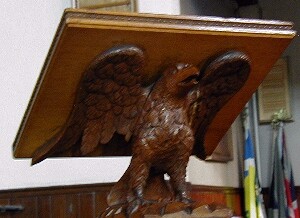
Eagles are symbols in many different ways. An eagle is one of our national symbols because it is perceived to be strong, fearless, and a ruler of the skies. It is also a religious symbol. In many Episcopal churches, the lectern base is of an Eagle with outspread wings- symbolizing the spread of the gospel. It is also the symbol of St. John.
One of the hymns that celebrate the words of the prophet Isaiah is by Michael Joncas, the first verse of which is:
You who dwell in the shelter of the Lord, who abide in his shadow for life, say to the Lord: ‘My refuge, my rock in whom I trust’. And I will raise you up on eagle’s wings, bear you on the breath of dawn, make you to shine like the sun, and hold you in the palm of my hand.[2]
No matter what your challenges, no matter that we haven’t done something that way before, if we dwell in the shelter of the Lord, then God will raise us up on eagle’s wings and bear us on the breath of dawn and make us to shine like the sun all the while holding us in the palm of God’s hand.
Remember Victor, the young boy who was blind and couldn’t walk – but still wanted to serve the Lord by being an acolyte? Well, thank goodness for people who looked for a way through. Thank goodness for people who see the Lord’s hand in the challenges before us. Victor is an acolyte. Yes, accommodations had to be made to give Victor his dream. But people saw a “yes” where so many others might have simply said “no” because that was easier.
Victor carries the cross on Sunday mornings. Someone thought to make a holder at the bottom of his wheelchair into which the cross could be placed. And someone else volunteered to push Victor’s wheelchair. And someone else helps Victor receive the bread and the wine. The body and blood of our Lord Jesus Christ. The cup of salvation for one who though weak in body is yet strong in faith. The bread of new life for one who knows God is his refuge and his rock. One who has trust that God will raise him up on eagle’s wings and bear him on the breath of dawn to shine like the sun. Victor is held in the palm of God’s hand.
Verity Jones reminds us that the “meaning of life is not often revealed on a mountaintop . We get to know how God works in the world through years of living with God and God’s people.”[3] I give thanks for the people of St. Aiden’s, Milton, GA who saw in Victor someone who loved God and wanted to serve – and worked to find a way to “yes.” Trusting in the Lord that the dream of this young man – challenged in so many ways- could come true. And they are blessed and we are blessed because someone said “yes”.
As you leave this place and go forth into the world, keep your eyes and ears open for ways that we are being asked to say “yes.” God is our strength and our refuge. God will raise you up on eagle’s wings and you are set free through your faith in God to be a witness to the healing power of God’s love – even in the most unlikely persons and places. Even in you!
[1] http://episcopaldigitalnetwork.com/ens/2012/02/03/parishs-acolyte-ministry-includes-those-with-special-needs/ (February 4, 2012). [2] Michael Joncas “You who dwell in the shelter of the Lord.” Wonder, Love and Praise (New York: Church Publishing Corp, 1997), 810. [3] Verity Jones in Feasting on the Word, Year B, volume 1. (Louisville: Westminster John Knox Press, 2008), 316.