
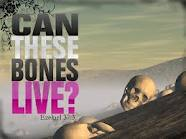
Ezekiel 37:3 – “He said to me, ‘Mortal, can these bones live?’ I answered, ‘O Lord GOD, you know.’”
Birthdays – most of us like them even if we profess to not need all that “foolishness” now that we are grown. Birth – day: a day to celebrate another year of life. A day to celebrate the family that birthed us.
Birthdays can also be bittersweet times in our lives- when we remember the birthday of one who no longer is living or when we don’t know where someone once loved is.
My heart aches for the Patz family- 33 years ago on Friday their son Etan vanished. Several years back someone was found guilty of his death in a civil lawsuit. Now it looks like that person didn’t commit the crime but someone else did. Just imagine how the parents of Etan have been living in a valley of dry bones for so many years, their son missing, presumed dead but not certain. Perhaps after that civil court decision they began to put the ligaments back on their bones. And now, it probably feels like that fragile life they began to rebuild has been ripped apart again. Dry bones once again. How do you go on, not knowing once again. Where do you find your hope?
Although the Patz’s are Jewish, perhaps they find some comfort in the day we call Pentecost and Jews call it Shavout. This day is a celebration of the day the Torah was given to the people of Israel. The giving of the Torah- the teaching- is a day to celebrate. A birthday: the day of life given by God to God’s people. The day on which they received teachings by which to structure and order their life so that they might be a light to the world.
For Christians, Pentecost is the day we celebrate the coming of the Holy Spirit – the Advocate and the Spirit of Truth- to those gathered together. Pentecost is the feast day of the birth of the church.
Ezekiel tells us about his vision of the Valley of the Dry Bones. Many of you may be hearing the childhood song “Dem Bones” that always cracked us up when I was little. We jumped around naming the various bones that were connected to the others: the foot bone was connected to the ankle bone and the ankle bone was connected to the shin bone – and on it goes. It makes me smile even now. Good memories of times spent playing outside with other children. Being connected to each other.
God asks Ezekiel: “Mortal, can these bones live”? And Ezekiel, knowing from whom all life comes, replies wisely: “O Lord God, you know”. Smart man. Ezekiel knows that his is not the power to bring life to a valley of dry bones. Only God can infuse life where there is no life. Only God can make the bones sing and dance. Only God can offer us the relationship that makes us fully alive. Ezekiel, a priest and a prophet, reminds us that while we are children of God, it is God who is in control. We act at God’s commands, yes. But it is God who commands, not us.
How often, though, do we think it is we ourselves who possess the power of life and death? We think we are in control. And, how often do we crash and burn because of our pride? Because we fail to honor the One from whom true life truly comes.
What is life without relationship? What is life without an understanding of who we are and whose we are? Ezekiel knows that it is God who can bring life from death. It is God who gives us the teachings by which we are to live. It is God who breathes on the dry bones, causing them to reconnect with each other. The Valley of Death becomes a Valley of Life.
I love the Book of Ezekiel. It is definitely strange. It is definitely not an easy read. Maybe I like it because some Jewish traditions hold that it shouldn’t be read by anyone under age 30[1], an age at which it was thought wisdom and maturity were fully developed. So, at least in years past, there was an excuse for shaking my head and putting it aside.
The Book of Ezekiel was written just before and just after the Israelites went into exile in Babylon. They were violently torn away from their home. Their relationships were disrupted. Their future was uncertain. The promises they thought they had from God – of being a chosen people, of being a light to the world, of becoming so numerous that they filled the world – all of those promises now seemed to be dead or at least dying. Once again, like the time in Egypt, they were in exile. The Valley of Dry Bones was real.
The hand of the Lord – the spirit of the Lord – is put upon Ezekiel so that Ezekiel may prophesy to the dry bones – the people of God who had traveled so far from God that they had become dead. Whose dreams of the world God set before them had withered and died and so they died, too. But God’s breath comes to them. They are reconstituted a people. People sent to love and serve the Lord. People, through the breath of God, are reunited with their purpose and returned to their own soil.
Note that the dry bones are joined, then the sinews, then the flesh and then the breath. Growth from the inside out. To be truly alive, the word of God starts in the depths of who you are. It then is evidenced by what you do and say. From the inside out. Bones provide the framework on which the rest of our physical body rests. Bones tell a lot about us.
Perhaps you have seen the TV show “Bones” or read the books by Kathy Reichs on which that series is based. Her protagonist, Temperance Brennan, is a forensic anthropologist. Tempe, as she is called, spends her days delving into the mysteries found in bones. Through scientific research, a forensic anthropologist can tell a lot about those bones. How old the person was, whether the person was male or female, likely ways that the person died and so forth. God doesn’t need to be a forensic anthropologist. God knows that we belong to God. And it is through God’s grace that we have life. That we grow from childhood to adulthood and to old age. Our call is to listen from God – in everything we do and say.
Once the breath of God is within us, we are changed forever. We are children of God sent to live within the world as witnesses to the power of the Holy Spirit- the Advocate and the Spirit of Truth. May your community see in you the numerous ways in which the breath of God has changed you from dry bones to one who proclaims the risen Christ. Amen.
Share