
Why are we so afraid to let go of our fear? Why do we want to hang on to something that constricts our life because we are afraid?
At the beginning of the gospels- the birth narratives- the angels say “do not be afraid”. At the end of the gospels- when the women go to the tomb to find the body of Jesus is missing, the angels say “do not be afraid.” And yet, we are so often afraid. And our life is circumscribed by our fear.
Our anxiety goes up – our blood pressure goes up- when we are afraid. All kinds of negative things happen to our body when we are afraid-or stressed or anxious. Why would we want to hang on to that fear when letting go of it has the effect of being better for our physical and our emotional and spiritual health?
At the end of the day, as evening came, Jesus is beset by people all around him. He cannot find peace with everyone pressing in on him. He looks for a way to find some quiet. He tells the disciples to get a boat and that they should go to the other side. They should leave where they are to seek some quiet and find some rest. They leave the place they know and where they are known. They take off across the Sea of Galilee for the land of the gentiles- the land where they are not known, or not known as well. They leave their own place for a foreign place.
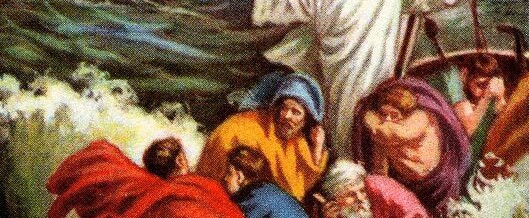
As they cross, a great windstorm comes up and the boat was being swamped. Water was pouring in. The boat was becoming less and less able to navigate the crossing. Fear entered the lives of the disciples. They were afraid of drowning. And, they looked to the stern of the boat and there was Jesus, sound asleep. How could he sleep through the storm? The wind shrieking through the shrouds. Things were probably being thrown this way and that in the cockpit. How could he be sleeping when they were surely going to die in the next few minutes!
Did Jesus not care? Did he not understand how dire their situation was? And somebody probably got mad and went to wake Jesus up. If I’m going to die, you’re not going to sleep through it! Jesus, don’t you care about us? Don’t you understand that we’re about to die? After all, Jesus was not an experienced fisherman- but 4 of his disciples were. They understand the danger. Maybe Jesus just didn’t get how serious this storm was.
Oh, Jesus knew all right. And Jesus knew that fear wasn’t the answer. Jesus stood up and rebuked the storm: “peace! Be still.” And it was so.
The winds ceased and there was a dead calm. “Why are you afraid” Jesus asks. “Have you still no faith?” Sadly I imagine- these disciples, the ones who had been with him for a long time. The ones who had seen him heal the blind and the lame and the deaf. The ones who had sat at his feet or around a campfire, listening to him preach and teach. And yet, even these disciples still didn’t have faith in who he was and in what he could do.
When the storm came up, they were afraid. They were afraid of what might be- of what they could not control. Jesus shows them and us that even when we cannot control the outward world, we can choose to live in faith. Jesus is not afraid – Of the storm, Of the Roman occupation and those sent to arrest him, Of the religious authorities who want his blood because Jesus challenges their authority. Jesus is not afraid because his faith is solid in the love of God. Regardless of what happens to Jesus in his physical body, the love of God is with him.
Jesus knows the source of light and life and our being. The faith of Jesus brought order out of the chaos of the storm. The quality of his faith changed what was life threatening – water that could drown becomes dead calm. Water that could have killed becomes once again water that supports the fish that are the main staple of their diet.
Mark Edington, chaplain at Harvard College, says that Jesus changed the nature of the threatening water by giving it- And the disciples, And us, What we need. “Peace. My peace I give to you.” Not the peace of the world but the peace that passes all understanding. Peace which enables us to look our fears in the eye and enables us to say: I am no longer afraid. I will rest in God’s peace which enables us to bear all things. To rest in quiet confidence that God walks with us regardless of what the world throws at us.[1]
Michael Lindvall, a Presbyterian pastor, commenting on this Gospel passage, says that there is a difference between “there is nothing to be afraid of” and “do not be afraid.” The first, which is what the mother says to the frightened child, is not always true. There are scary and frightening things in our world. Bad things do happen to good people. Do not be afraid says we don’t have to be limited or frozen and unable to act even when those frightening or scary things happen. We can choose to look our fears straight in the eye and say “I rest with Jesus. Jesus can calm the waters that are threatening to kill me. God is with me no matter what happens in my world. I do not have to left my situation limit my life.” Jesus tells the water to be still. He doesn’t cause the waters to evaporate. He causes them to be still. The boat can now be bailed out and the continue on its way to the other side.
We can rest assured that we do not walk alone. God is with us regardless of what is going on around us. Patrick Overton’s poem, Faith reflects on this passage:
When you come to the end of all the light you have
And take the first step into the darkness of the unknown,
You must believe that one of two things will happen.
There will be something solid for you to stand upon
Or you will be taught how to fly.
I like his poem and I disagree with his conclusion. Jesus provides the solid ground for us to stand upon. And Jesus teaches us to fly. Jesus is a “both/and.” Yes, there are frightening things in this world. And we can respond in fear- limiting our life and our ability to live. Or we can follow Jesus’ example and say “Peace, be still.” We don’t have to ignore the events or situations that are fearful. We can rest, though, in the certainty that God is with us, no matter what we face.
Why are we so afraid to let go of our fears?
[1] Mark Edington and Michael Lindvall in Feasting on the Word, Year B, Vol. 3 (Louisville: Westminster John Knox Press, 2009), 164, 166.