
“Because I said so” has never been a very acceptable response in my life. “Because I am the Mom” follows close behind. Questions arise because something has happened- something has aroused my curiosity- or something hurtful has happened that makes me sad, confused, bewildered, uncertain. Answers are important in helping me make sense of the world I live in. And how I am to go on with my life.
Like most of you, I suspect, I like a world that is ordered and orderly. Where I know the rules and the responses to “correct” behavior. Where I don’t have to struggle everyday with the simple things that make life easier. And when something happens to knock me out of my regular, ordered and orderly, routine, the questions start coming. Why did this happen? What did I do? Where do I go now? How do I respond? Too often, the response is: That’s not fair! – meaning it’s not what I expected in response to my behavior and my understanding of the rules of life.
Today is the third in four readings from the Book of Job. A type of scripture classified as “wisdom literature.” Writings that can tell us something important about our lives and our relationship with and response to God.
Here’s where we are:
- Job’s whole world has been turned upside down.
- He struggles with the loss of all he held dear – his family, his home, his health.
- He struggles with a God that seems not to hear him or his desire to plead his case and prove that he, Job, is blameless.
- He struggles with his friends who insist that Job must have sinned- because only sinners suffer.
- Job pleads with God to hear his case and then to render judgment that will put Job’s life back together again.
Today’s reading is a classic case of “be careful what you wish for”. God does respond to Job but it’s not the answer Job thought he was going to get. God doesn’t answer Job’s fundamental question of why bad things happen to good people. God doesn’t dispute that Job has been good- after all that’s the basis of the wager between God and the Satan.
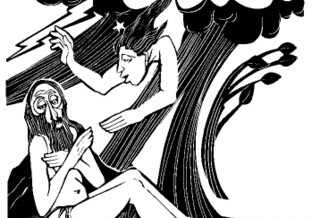
God knows Job is good. God knows that Job has followed all the rules. God’s response to Job is a bit like a reporter: who, where, when, why, how. The fundamental outline for a reporter when covering a story. “Who is this that darkens counsel by words without knowledge?” God thunders from the whirlwind.
“Where were you when I laid the foundation of the earth?” And on and on God goes with the questions. God successfully puts Job – and us- in our places.
This passage reminds me of the Prayer of Humble Access found in the Eucharistic Prayer in Rite 1 (BCP 337) – “I am not worthy so much as to gather up the crumbs under thy table.” Like Job, I am mortal, fallible, and I sometimes wonder why God has chosen to notice me. But remember also the next sentence: “But thou art the same Lord whose property is always to have mercy.” God hears our cries just as God heard Job’s cry.
Theophany means the appearance or the manifestation of God. The Hebrew Scriptures are full of theophanies:
- God breathed on the chaos and the waters calmed and creation of our earth began
- God spoke to Abraham and stayed his hand from killing Isaac
- God was in the burning bush
- God was the pillar of cloud by day and flame by night while the people were in exodus
- God was the still, small voice following the wind and the earthquake when Elijah was on the run.
And God spoke to Job from the whirlwind. God appears in history over and over again. God is with us if only we will shut up and stop, look and listen. If only we will get out of our own way and our own demands that life be as we want it to be. If only we will acknowledge that we do not have control over everything.
Some things are simply beyond our control. Some things are beyond our knowledge or understanding. That doesn’t mean we stop asking questions or seeking answers.
An easy response to God’s speaking from the whirlwind is to say, “ok, you’re God and I’m not so I’ll just shrug the questions off and blindly believe.” Another is to say “yes, I’m just a worm and not worthy of your notice. Poor me.” Neither of those responses is very helpful or responsible.
After all, if God does act in history- if God does appear to humankind – if God does speak from the whirlwind, then perhaps we ought to pay attention and think about what response does make sense. Perhaps we ought to become a bit more comfortable with discomfort. With changes to our routine. With God’s effort to change our life to more fully reflect our understanding of God and God’s call to us to be fully human.
Thomas Frank asks: “Why do people ask why? Especially when they know good and well that there is no answer…If asking why is some feeble attempt to get control of their life and bring it to sense and better management, God’s response gives humanity even less sense of control than before.”[1]
As humans, we have trouble living with ambiguity and uncertainty. And so we ask why even when we know there is no answer. We keep hoping that this time there will be an answer that satisfies. An answer we can wrap our heads around, put the question and the answer to bed and move on.
Well, don’t expect that from the Book of Job. We do get some thoughts about the questions, though, that may help us live with the tension and ambiguity.
- Although it may not seem like it at times, God does care about Job- and thus, us.
- We are part of God’s creation and as such we are important to God.
- We are capable of living with and through situations which make no sense to us when we understand that God loves us and is with us in the most difficult times we face.
- God has appeared time and again to humankind in history. God desires relationship with us even though we are not necessarily the center of God’s universe, so to speak.
- God is God and we are not-meaning that there always will be questions to which the answers we can posit leave us wanting more.
Like Job, do not be afraid to seek – and to be found- by God. Do not be afraid to ask questions about things that puzzle or hurt us. And understand that God may speak to us from the whirlwind. And be prepared.
Annie Dillard, in Teaching a Stone to Talk, offers this meditation that might be about God speaking from the whirlwind: On the whole, I do not find Christians, outside the catacombs, sufficiently sensible of the conditions. Does any-one have the foggiest idea what sort of power we so blithely invoke? Or, as I suspect, does no one believe a word of it? The churches are children playing on the floor with their chemistry sets, mixing up a batch of TNT to kill a Sunday morning. It is madness to wear ladies’ straw hats and velvet hats to church; we should all be wearing crash helmets. Ushers should issue life preservers and signal flares; they should lash us to our pews. For the sleeping god may wake some day and take offense, or the waking god may draw us out to where we can never return.[2]
Job’s life will never be the same. Our lives, when we ask questions and struggle for answers about God and the question of innocent suffering, are never the same. Maybe we do need crash helmets. Maybe we do need signal flares. Maybe we do need to be lashed to our pews so that we don’t cut and run at the first sign of discomfort or unanswered questions or hurt or loss. One thing I am sure of, though, is that God is my life preserver.
Maybe not quite the orange or yellow one that buckles around my middle with the handy, dandy, tube that I blow into once I’ve left the plane and slid down the ramp. But my life preserver does have a light that automatically turns on when I’m in the water and the waves are deep and my life is in peril. And God sees that light- and God reaches out a hand to haul me into the raft. And I am safe when I am with God. Thanks be to God. Amen.
[1][1] Thomas Frank. Feasting on the Word, Year B, vol. 4 (Louisville: Westminster John Knox Press, 2009), 172
[2] Annie Dillard. Teaching a Stone to Talk (New York, Harper & Row, 1982.