
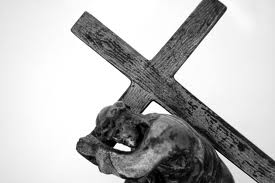
Then Jesus began to teach his disciples that the Son of Man must undergo great suffering, and be rejected by the elders, the chief priests, and the scribes, and be killed, and after three days rise again. He said all this quite openly. And Peter took him aside and began to rebuke him. But turning and looking at his disciples, he rebuked Peter and said, “Get behind me, Satan! For you are setting your mind not on divine things but on human things.” He called the crowd with his disciples, and said to them, “If any want to become my followers, let them deny themselves and take up their cross and follow me…” (Mark 8: 31-34)
Jesus is not saying – I repeat most emphatically NOT saying– that you must remain an unhealthy or unsafe situation as “your cross to bear.” Jesus is saying that our human life will have its crosses: times when we must choose whom we will follow. When we must choose our values and how those values get lived out in our lives. Times when we have to go against the values and desires of those around us if we are to remain true to the good news of God in Christ.
There was a time – and for some the time is still now- when a woman would come to her pastor and say “Pastor, my husband is beating me. I want a divorce.” The pastor would reply: “no, this is your cross to bear.” This is not, in my understanding, what Jesus was talking about – and I believe that Jesus would be appalled to think that someone is being told to stay in an unhealthy and unsafe environment as what God wants for us. Domestic violence is wrong. Domestic violence does not respect the dignity and worth of every human being. Domestic violence is not respecting the Christ in each other. What Jesus is telling the disciples and those in the crowd with them is that life has its ups and downs. Life has its temptations- that Peter’s urging Jesus to avoid suffering and rejection and death is a temptation of the devil, of Satan. Jesus reminds Peter- and all of us- that our way is the way of suffering and death and resurrection. Without the cross there is no resurrection.
Each Sunday we begin our service with a procession. The procession is led by a cross. A symbol of suffering and death that leads to new life. Some things must die in order that new life may come. Lent is a time to reflect upon what the temptations are in our lives that need to be set aside or need to die in order that new life might come.
Martin Luther is credited with developing – or at least naming- a theology of the cross. That the cross is the only way to understand Jesus: who he was and how he represents God to us. That the cross, as a symbol, is both an instrument of execution and the means of salvation. The cross reminds us that God is in charge and we are not. Without the cross, there would have been no resurrection. Without the resurrection, Jesus likely would not have been remembered or at best would be a footnote in a history book. Just another criminal put to death for treason against the state. Peter, like many of those in his time, believed that a Messiah was an earthly king. Someone who would defeat the powers of the day – and so James and John and their mother sought places at his right hand and his left hand. They were each focused on what they believed a Messiah was. Jesus was not that kind of Messiah – which is likely one reason so many turned against him at the end. If you can’t be who and what we think you should be, then we’ll turn our backs on you.
Evangelist Arthur Blessitt made the Guinness Book of Records in 2008 for completing the “world’s longest walk”: a 40 year, 38,102 mile trek around the world, all while carrying a 12-foot-high cross.[1] Blessitt says about his journey: I have now walked and carried the cross through 315 nations, territories and major island groups, this includes every nation and continent covering 38,102 miles, which is more than 1½ times around the world at the equator. The journey has gone through cities, deserts, mountains, jungles and 52 nations at war. I was chased by elephants, attacked by baboons, a crocodile and a green mamba snake. I have been arrested, jailed or taken in for questioning two-dozen times. Once I was taken out to be shot before a firing squad. This has been through rain, cold, snow and extreme heat. My passion and mission has been to obey the call of Jesus and lift up the cross and the love of God to all peoples. The welcome has been glorious with villages and towns gathering to greet the cross and hear the message of Jesus. I have walked around the world but I have carried a cross. The cross is about Jesus and Jesus is about Love.
As people come to the cross they feel this love and hope. No matter what nation or religion people are equal at the cross. Even in the most hopeless places wracked by hunger and war, people would gather at the cross.[2] “As people come to the cross, they feel this love and this hope.” This instrument of torture and death is transformed into a symbol of love and hope. This season of Lent is a time to reflect upon our lives and our faith. Is there something where you might need to say: “Get behind me Satan- for you are focused not on divine things but on human things.”
One of my favorite Easter hymns is “Lift high the cross” – and yes, that made the list of hymns when we asked you for favorites last fall. And we’ll sing it during Easter. The cross becomes the place where life and death meet. Where the love of God transforms the instrument of torture and death into the symbol of eternal life. Where we learn to keep our focus upon the divine and to set to its proper place the concerns of the world. The cross is not an insurmountable barrier. It is transformative. We look through the cross to what lies beyond. A cross is an icon because it is an item – a cross- and it is so much more. It is a symbol of what God can do. God can take the worst acts of humanity and turn it into our salvation. The way of the cross reminds us that our hope and our life lie in understanding that Jesus came to give us life and to give us abundant life. This life requires that we keep our focus on God who is capable of transforming that worst that we can do. This cross that is an instrument of torture and death becomes a rallying point as a symbol of love and hope.
More than any other feature, the cross marks a building as Christian. It is “the” symbol for Christianity. We do not need to fear it. We are called to be transformed by it. We are led into worship behind the cross. We go into the world to love and serve Christ following it. Each of us will have a cross to bear- something that seeks to take our attention from divine things and put our attention on human things. We can choose, with God’s grace, to keep our focus on divine things and live our lives as witnesses to the good news of Jesus Christ. We do that when we “lift high the cross, the love of Christ proclaim, till all the world adore his sacred name.”
Share