
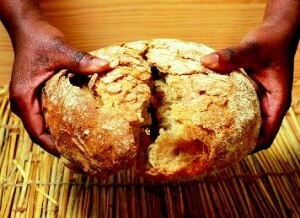
“I am the bread of life. Whoever comes to me will never be hungry and whoever believes in me will never be thirsty” (John 6:35). What’s the difference between this (hold up piece of bread) and this (hold up Eucharistic wafer from reserved sacrament)? They are both bread. They look different and they taste different – but they are both bread. They both are part of our diet, enabling us to live. When someone goes on a very low carb diet, bread is often what they miss the most –the one food whose absence makes it very hard to stay on that diet for an extended period of time.
Bread –and its importance in our lives-may be hard-wired into our unconscious. During the Exodus, the people clamored for bread (Ex. 16). They grumbled against Moses, saying “If only we had died by the hand of the Lord in the land of Egypt, when we sat by the fleshpots and ate our fill of bread; for you have brought us out into this wilderness to kill this whole assembly with hunger” (Ex. 16:3). And God – perhaps exasperated at their grumbling- told Moses that God was “going to rain bread from heaven” (Ex. 16:4). So there! Take that, people of Israel. You want bread, I’ll give you bread.
And then there’s Elijah the prophet. Elijah goes to visit the widow in Zarephath when the ravens who were bringing him bread at the Wadi Cherith stopped after there was no rain in the land (see 1 Kings 17). Elijah tells the widow to bring him water and to bring him meal-and she replies that she has only a little meal and little oil –and was on her way to make a last meal for herself and her son. Their food had run out and they were sitting down to die once they ate this last meager meal. But because Elijah was known as a prophet of God, she did as he asked. Her grain and oil multiplied and fed them for many days.
Two weeks ago we read the feeding of the 5,000 (John 6:1-21). Five small loaves are multiplied to feed those gathered with fragments left over sufficient to fill 12 baskets. The symbolism of 5 small loaves feeding the multitude with sufficient fragments left over to fill 12 baskets might be that the life given to us by God is beyond anything we can ask or imagine. “I come that you might have life and have it abundantly”, says Jesus (John 10:10).
Then last week we picked up the story on the day after the feeding of the multitude. Jesus begins his teaching about the bread of life- the food that never perishes. Jesus reminds those who had followed him from that hillside that it was God who provided the manna- not Moses. Jesus tells them “For the bread of God is that which comes down from heaven and gives life to the world” (John 6:33). Jesus refocuses those gathered on the one from whom life flows: God.
Today’s reading continues the discussion between Jesus and those who had followed him from the hillside. “I am the bread of life. Whoever comes to me will never be hungry and whoever believes in me will never be thirsty” (John 6:35). And, as we’ve seen before, there’s grumbling and disbelief and isunderstanding. “Is not this Jesus, the son of Joseph, whose father and mother we know?” (John 6:42). How can this one whose family we know presume to speak for God? The “facts” get in the way of the “truth”. Or, there are none so blind as those who will not see.
Jesus calls our attention to Moses as the one through whom God worked the miracle of manna. Moses did not provide the bread that made life possible. God did. Jesus now tells us that he is the one through whom eternal life is possible. Jesus is the one who now gives us bread that is life-giving.
Sister Suzanne Toolan wrote the hymn “I am the bread of life” in 1966.[1] She “had been asked to write a song for an event in the San Francisco archdiocese. With the deadline looming, she worked on a song in an unoccupied room next to the infirmary in the Catholic girls’ high school where she taught. ‘I worked on it, and I tore it up. I thought, ‘This will not do,’ Toolan said. ‘And this little girl came out of the infirmary and said, ‘What was that? That was beautiful!’ I went right back and Scotch-taped it up. That schoolgirl saved “I Am the Bread of Life.” A version of it is in our hymnal as number 335.[2] The first verse is
I am the bread of life
they who come to me shall not hunger
they who believe in me shall not thirst
No one can come to me
Unless the father draw them.
And I will raise them up
And I will raise them up
And I will raise them up
On the last day.
Bread as the symbol of life and of relationship with God. In the Lord’s Prayer (Mt. 6:9-11), we say: “Give us this day our daily bread” once again reminding us that bread is integral to life and to our relationship with God. It is God that gives us the bread that leads to eternal life. Just like those in the wilderness, this is bread that is given daily. Not to be hoarded. Bread that needs renewing daily just as our relationship with God needs remembering daily.
The symbolism of bread as life and of our meals together is celebrated in the Eucharist. Jesus tells us that the bread that he gives for the life of the world is his flesh (John 6:51).
Sr. Toolan continues in verse two with these words:
The bread that I will give is my flesh for the life of the world
And they who eat of this bread
They shall live for ever
They shall live for ever
And I will raise them up
And I will raise them up
And I will raise them up on the last day.
In the Eucharist, we say: On the night before he died, our Lord Jesus Christ took bread. And when he had given thanks, he broke it and gave it to them. …Take and eat. This is my body which is given for you. Do this for the remembrance of me. Take. Bless. Break. Give.
The reminder to us that bread is not just bread. Wine is not just wine. They are symbols to us – then and now- that Christ died for us. That we have the promise of eternal life when we take and eat of the bread that is Christ’s body. When we drink the wine that is Christ’s blood. When we celebrate that this bread and this wine are the Gifts of God for the People of God.
Yes, this is bread and this is bread (holding up regular bread and consecrated wafer). Both give nourishment. Both help sustain life. But the body of our Lord Jesus Christ, given to us through God’s love, gives us eternal life. Eat, drink. Remember the source of light and life. Remember the one from whom all life flows. Each time you eat and drink give thanks for the true bread, Jesus Christ our Lord. Amen.
[1] http://natcath.org/NCR_Online/archives2/2007d/110207/110207e.htm (August 11,2012).
[2] Hymnal 1982 (New York: Church Publishing, 1985), 335