
Is there Good News in the Book of Job? Why is this scripture included in our Canon? Question after question – and so few answers. It almost makes me want to ignore the text as being too removed from my life. Not relevant. Maybe back then but not today.
Most of us, if not all of us, gathered here today have had a pretty good life. Sure, we have had our troubles. We have had our sorrows. We’ve smiled when things aren’t going so well. We’ve responded “I’m fine” when we’re really not – because that’s what you do in public- and even with your family sometimes.
Yes, each of us has troubles and disappointments. We have lost a job- or not gotten a job. We have watched our parents – or siblings or spouses – or perhaps even a child, die. We live with chronic pain and doctors who tell us that there isn’t anything else they can do for us. We have struggled with wanting this or that even as we intellectually know that we have so much more than most other people on earth.
We watch the nightly news and learn about Malala Yousufzai, the 14-year old Pakistani girl shot because she was promoting education. I am angry that this happens- but my anger mostly remains in my head and not my gut. I’m removed from this and other terrible events. There isn’t anything tangible I can do about Malala’s situation.
Job and his troubles seem so far away- so far removed from our life that we can shrug it off as “that’s nice” – and it remains an intellectual exercise rather than a gut-wrenching experience.
Perhaps the Book of Job is a bit like algebra. I have to learn it because somebody decreed long, long ago that it was to be part of the curriculum. It’s just there as part of what you have to learn in 9th grade. Nobody believes they will have to use it again – it’s irrelevant. Or, if it is relevant, we now have computers who can figure out all the variables and solve the equations. It becomes something to sit through until we get to the good stuff. Yawn.
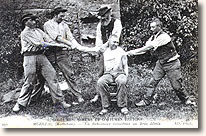
Algebra comes from Arabic and means “the reunion of broken parts.”[1] It also means “bone-setter.” Job’s story is about both of these definitions, really. Job’s life has been shattered and is in many broken parts. Job needs a bone setter. A bone setter is someone who sees brokenness and helps realign the broken parts so the brokenness is back to the original straight limb. Then, the bonesetter wraps or casts the broken pieces and tells us to let them heal. And, in time, if we pay attention to the instructions, the bones knit together and we are able to walk or throw a ball –or do what we used to do, as well as we were before the bones were broken.
And sometimes, if we don’t get good help or we don’t pay attention to the bonesetter’s instructions- the broken bones don’t heal straight and we’re left forever after with a limp or a crooked arm. We’re left with pain that reminds us daily about what was broken and did not heal correctly.
Job’s story reminds us that life is not always fair. God is not always fair or just at least as we define it. God is not someone put in a box and stored on the top closet shelf while things are going right only to be taken down when things go wrong.
Thomas Frank reflects that “the Christian life presents no greater challenge than finding one’s way forward with integrity and responsibility in the dark.”[2] Job cries out that if only he could confront God and present his case, then God would surely respond. After all, God is merciful and just.
Where is justice, though, if Job’s situation is a result of a bet between God and the Satan? A bet in which God responds to the Satan’s taunting by saying, “ok then- you can mess with Job and take all that Job has- just spare Job’s life.” What did Job do to deserve this? Nothing. Job is the pawn between God and the Satan in their discussion about whether Job- and human beings in general- can remain faithful to God when God seems to be absent.
When I look for God and cannot find God. When I go forward but God is not there – or backward and I cannot perceive God- or turn to the left and God hides- and turn to the right and God cannot be seen. When, in the words of Psalm 22 “My God, my God, why have you forsaken me? And are so far from my cry and from the words of my distress?”
And does this passage- or even the whole book of Job really have any relevance when our life is going well? Maybe it is really just something I’ll put aside until – if – the day comes when life turns upside down. And then I’ll pray that I never experience the situation that Job does. That’s a nice lesson for other people but not for me.
One of the cultural lessons learned from hospital chaplaincy is that many of us were taught that it is not ok to be mad at God. We are to bow our head and accept whatever is handed to us- and to smile and respond “the will of God, thanks be to God!” The Book of Job and the Psalms tell us the opposite. It is ok to be mad at God when life is unfair and unjust and confusing.
Job challenges God – in fact, he really rants and rails at God. Where are you, God? Why is this happening? What did I do to deserve this? The hard part is that, at least at this point in the Book of Job, God doesn’t answer.
My complaint is bitter. I look to the left- I look to the right- I look ahead of me and behind me –and there is no God. If you aren’t here, God, then I wish I could vanish in the dark. Job is right to be befuddled and confused and angry. What has happened to Job isn’t the way his society said life would be. It isn’t fair. It isn’t just. It isn’t how he understood the relationship between himself and God to be. Job’s life is broken into many pieces. Job needs a bonesetter – someone who can reunite those broken pieces.
When we believe that we are in control, we can be deaf to other ways of doing things. We can be deaf to our own faults and our own limitations. Sometimes a situation needs breaking in order to become stronger. Sometimes we need a bonesetter who works with us in our pain and our confusion.
Ranting and railing against an unfair situation can exhaust us. You’ve seen it – the young child who screams he isn’t tired when you see the heavy eyes and the cranky behavior. He insists he doesn’t need a nap. And then in the next instance is sound asleep. The emotional temper tantrum has worn him out. Now he can take that nap he so desperately needs.
Ranting and railing to God when God seems to be absent. I cannot find God when I look to the left and to the right. I cannot find God when I look before me or behind me. I exhaust myself with my demands that God do what I want. Only then does God appear. God’s been waiting for me to wear myself out with my demands that God behave in a certain way. Maybe it isn’t today. Maybe it isn’t tomorrow. And maybe for some people it will never be. But for many of us there has been or there will be that dark night when we need a bonesetter.
The Book of Job and the Psalms remind us that we can rant and rail to God. It is ok to feel lost and lonely. We do not have to deny that we are in pain. After all, there is a bonesetter on call. Amen.
[1] http://www.etymonline.com/index.php?term=algebra (October 13, 2012).
[2] Thomas Frank in Feasting on the Word, Year B, Volume 4 (Louisville: Westminster John Knox Press, 2009), 148.