
How do we know what we know? There is an old adage: tell your audience what you are going to tell them. Tell them. And then, tell them what you just told them. Many of us need to hear some things several times before it sinks in. Particularly today when we almost never have true silence or real quiet. When many of us have lost the practice of reflection. When it is hard to hear God because there is no such thing as the sheer silence that Elijah experienced (see I Kings 19:11-12). Today the television or radio or internet is blaring with news 24/7.
Information overload is common – sometimes leading to a shutdown in our ability to take any information in. Indeed, one common acronym is “TMI” or “too much information.” When we overhear someone’s cell phone conversation in a public place and learn much too much about something or someone that we really wished we didn’t now know.
Many of us need time – and quiet- to truly incorporate teaching or information into our being, particularly when the information calls us to change the way we live or what we believe. We need time to know what we really do know. We need time to know that we have to act in response to what we know. You may even have had an experience like I have when you were told something and you just don’t quite get why it’s so important to the person who told you. And then one day, you hear it again and all of a sudden, your response is: “oh, that’s what it means.” I may have heard something several times and then for some reason, it finally sinks in. We need courage to live as we know we are called to live. Sometimes I feel a little bit dumb that I’ve taken so long to “get it.” But, better late than never!
The more of our senses we use when learning to know what we know, the more likely that something is to become embedded into us when we finally take it into ourselves. Sometimes taking that extra bit of time to understand what is being said means that the nuances come through in ways that an immediate acceptance might have short-circuited. Sometimes it take time and repetition to understand that something that may not be easy for us is worth taking a chance at. We’re so used to striving for perfection that when we know we don’t have certain gifts, we tend not to use those “partial” gifts at all rather than chance looking – or sounding- foolish or less than perfect.
Over the last several Sundays we have read parts of the Letter to the Ephesians. This Letter is filled with guidance about how we should lead a life as a believer in Jesus Christ, the only Son of God, our strength and our redeemer. Take for example the admonition in the reading today to “be careful how you live, not as unwise people but as wise” and “do not be foolish but understand what the will of the Lord is.” So how do we know what the will of the Lord is? How do we know what God is calling St. Andrew’s – and each of us – to be and to do in this place and this time?
One of the great aspects of the Episcopal Church tradition is that several lessons are part of the Daily Office and also at each Eucharist. We generally have an Old Testament reading, a Psalm, a New Testament reading and one from the Gospel. We have multiple chances, then, at each service to hear the Word of God proclaimed. We have multiple chances to see how the various parts interact. We have multiple chances to ask questions of ourselves and of the preacher. Plus, because we use a lectionary, we read most of the Bible in a three-year cycle. Over time, then, we will read the Bible multiple times in our life. Listening is important – but so is asking questions. It is not enough to passively listen to what is read or preached. As human beings with the gift of reasoning, we are called to listen, yes; but also to think and reflect; and to ask questions of ourselves and of each other.
What does this mean? I wonder what the context is for that passage? What changes do I need to make in my life now that I know what is God’s will for my life? Where do I need to risk reaching out to do something that maybe doesn’t come easy – or doing something even though I know I’m not “professional” quality. Why is it so hard for us to believe that God loves us just as we are? Paul’s letter to the Ephesians tells us how to live, warts and all. Certainly, Paul challenges us to be the best that we can be- but failing to be perfect at something is no excuse not to try.
Ron Allen and Clark Williamson suggest that the Letter to the Ephesians is split into two parts. The first part is “indicative” meaning it recites what God has done for us. The second half is “imperative” which tells us what our response to God’s action must be.[1] We need to be reminded that God acted first – God called us to be God’s people. God blessed us and we, in turn, are called to bless God. For the blessing given to us by God to become real, we must “act appropriately to our calling.”[2] Blessings require action on our part.
One of the affirmative admonitions from this passage of Ephesians that we “frozen chosen” seem to forget too often – at least in my opinion – is that we are to sing psalms and hymns and make melody to the Lord. There is a long tradition of making music to praise the Lord. Even King David sang and danced before the Lord (2 Samuel 6:14). Over and over again throughout the Bible we read about worship and praise to be given to God. Whether we are good at it or not we are commanded to worship the creator, the redeemer and the sustainer. We are to give thanks for all that is to the one who created all that is.
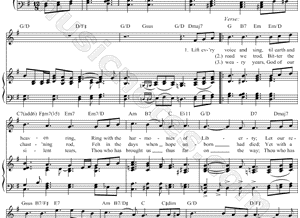
Music, as many of you who teach it know, involves several of our senses. Music is one way to incorporate into our very beings the joy that is due to the Lord. One of the additional musical resources authorized for the Episcopal Church is titled “Lift Every Voice and Sing” – and with all due respect to those who teach voice, this means not just the professionally trained voices, not just those who can carry a tune – but every voice. Every person can make “melody to the Lord.” And every person should. We know this- but do we act on it?
Music is a particularly wonderful means to give thanks to the Lord. Indeed, Psalm 98 tells us to “sing to the Lord a new song, for he has done marvelous things… make a joyful noise to the Lord all the earth, break forth into joyous song and sing praises” (Ps. 98:1a, 4). In a few weeks we will sing Hymn 412 and the refrain reminds us that “he has done marvelous things” – think on that and when it comes time to sing this hymn in a few weeks, may you know that these words are part of who you are as a child of God, one who has been marvelously made by God. One who is instructed by the author of the Letter to the Ephesians to sing songs and hymns and to make melody to our Lord, giving thanks at all times. Ephesians reminds us that this is part of the Lord’s will for our life. Rejoice and sing. Give thanks and praise to the Lord. For He has done marvelous things. Alleluia. Amen.
[1] Ronald J. Allen and Clark M. Williamson. Preaching the Letters Without Dismissing the Law (Louisville:Westminster John Knox Press, 2006), 157.
[2] Id, 158.