
What makes St. Andrew’s different from a social club? We meet weekly. We enjoy each other’s company. We listen to terrific music. We contribute to the upkeep of this place. We talk around the coffee pot and snacks. So far, this description sounds like most any “social club” – maybe not quite Rotary or Junior League, but pretty close. So what makes St. Andrew’s a “church” – a place that is social, in the sense that “social” is defined as marked by interaction with others of like minds. Another definition of social is that it has to do with “society” or how we live together and how we respond to those things that matter to us, as a society. What makes St. Andrew’s different from a social club? Again and again we come back to this question as we walk this transition path and ponder where St. Andrew’s goes from here in terms of calling a new rector. What makes St. Andrew’s different is the underlying mission and underlying values. There is nothing wrong with the mission or the values of Rotary or the Junior League or the Civic Club. They are all good social clubs.
But we are a church – we were created to be a shining light to all. We exist to spread the good news of God in Jesus Christ. We live so that others may see Christ in us – and seeing us, may be drawn to say “I want that, too.”What is this mission and vision of God in Jesus Christ and how does St. Andrew’s live it out?
Jesus died on Good Friday. Jesus rose from the dead on Easter evening. Doubting Thomas had been offered the chance to put his hands in the wounds of Jesus. The two men walking to Emmaus had spoken with Jesus. And still, Jesus appears to the disciples and they think he is a ghost. Jesus once again offers each of them the chance to put their hands in his hands and in his side- to feel the wounds. To put some flesh, as it were, on Jesus so that they might believe.
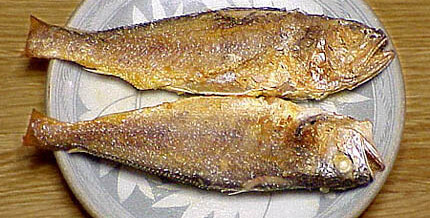
And yet, it takes a piece of broiled fish and eating together to open their eyes and their minds to the truth of Jesus Christ, crucified and risen. To understand that each of them were witnesses to the awesome power of God to say “yes” when the world says “no.” There is something special about eating together. The sharing of bread and wine. Life revolves around table fellowship. We sing today about “all who hunger gather gladly; holy manna is our bread… We that once were lost and scattered in communion’s love have stood. .. Taste and see the grace eternal. Taste and see that God is good” (Wonder, Love and Praise, 761: “All who hunger gather gladly”). There is something about eating the bread and wine that symbolize the body and blood of Christ that sets us apart from an ordinary social club. The Collect prays that we remember that Christ made himself known in the breaking of the bread. That breaking of the bread and drinking of the wine opened the eyes of faith – for the disciples then and for us today. In ways that we cannot truly understand, Christ is present in the bread and in the wine.
The Episcopal Church, in typical via media – or middle way- fashion, says that Christ is “truly present” in the Eucharist. The 1979 Book of Common Prayer returns to an earlier practice that holds that the Eucharist is the chief act of Christian worship on the Lord’s Day (Leonel L. Mitchell. Praying Shapes Believing (Harrisburg: Morehouse Publishing, 1985), 128 et seq). Leonel Mitchell, one of the great liturgists of the 20th century reminds us that the Eucharist is not the action of one person- bishop or priest- but rather is the action of the body of Christ. That Eucharist is the action of all of us gathered together. God is the principal actor- not human beings. Each of us – lay or ordained – has our part to play when we celebrate the presence of Christ among us in the bread and the wine.
No one is left out- young, old, male, female. All are welcome. The Eucharist celebrates the unity of the Body of Christ- regardless of what role we play on any particular Sunday. The Eucharist recognizes our diversity, including our varying gifts and talents. Each of us comes to the table to partake of the bread and the wine- the real presence of Christ, which both offers us solace when we are sad or lost and strength to face the day and week to come. It is a “both/and.”
In our Eucharistic Prayer, we remind ourselves that this is a sacrifice of praise and thanksgiving. A sacrifice in the sense of something being made holy – being set apart from the everyday business of our lives. A time to reflect and to refocus on God who gives us strength for our journey while giving us also the peace and knowledge that God can carry our toughest burdens. We call the Eucharist a sacrament. According to our Catechism (BCP, 859), a sacrament is an outward and visible sign of an inward and spiritual grace.
The outward and visible sign is the bread and wine. The inward and spiritual grace is that through eating of the bread and wine we are, once again, reunited with God while being prepared to be sent forth into the world to do God’s work. Because we come forward to kneel side-by-side at the rail, we are reminded that none of us is more special than any other person. Each of us is part of the body of Christ with varying gifts and talents to be used to help make God’s realm a reality on this earth and in this place.
One of the wonderful things about St. Andrew’s is the many, many gifts and talents and ways to serve that exist. At our Annual Meeting, we passed out a questionnaire entitled “Imagine.” The questionnaire asked what people valued most about St. Andrew’s. While we did not get as many responses as I had hoped, those we did get were pretty consistent in the replies. Music was one of the assets of St. Andrew’s. Music has had a special place in the hearts and minds of the people of this parish for a long time – and several times this building has hosted wonderful recitals or other musical offerings in addition to the music on a Sunday or at a wedding or a funeral. We had a wonderful jazz trio here on Shrove Tuesday. Open to all in the community, this musical offering livened up the eating of pancakes and sausage as we prepared to enter the season of Lent. In the fall, we hope to offer a celebration marking the 10th anniversary of the dedication of our organ. It will, like all of our offerings, be open to the public. We hope to get the word out so that others in the Greencastle and Putnam County area might come that day to celebrate with us the wonderful gift of music and musical instruments. Another gift mentioned in several responses to the “Imagine” questionnaire was the Non-Food Pantry. For those who participate in this ministry, it is a wonderful time of fellowship. It offers a response to those in our community who have needs not otherwise met. We have been blessed by the hard work and dedication of the leaders and all who volunteer each month to first solicit donations, to stuff the bags and then to distribute those offerings to persons in need. Remember the Scripture from last week – in the Acts of the Apostles, all sold what they had so that no one in the community had need. In addition, the Non-Food Pantry has been accepted as one way the students from DePauw can earn the service hours necessary to meet university requirements. Students and members and friends of St. Andrew’s work side-by-side to gather donations and then distribute them. We work together as the Body of Christ. The Non-Food Pantry is one way we reach out to those in our community who are in need. Another way is through Concessions. Page Cotton delivered a check in excess of $10,000 last week to us. That represents the very hard work of those of you who staff the Concessions stand through the fall, winter and spring athletic events. Not only does selling Concessions benefit the life and work of St. Andrew’s, it is also a wonderful opportunity for fellowship – and perhaps some sore muscles the next day – or a vow to never eat popcorn again after popping it for hours on end! Concessions are a ministry even if you don’t think of it that way. It is a time for the Body of Christ to gather and to provide a service to the community. The proceeds from Concessions are used, in large part, to fund the outreach and other ministries of St. Andrew’s. Another way St. Andrew’s meets the needs of the community is through our Memorial Garden. This space offers beauty and rest in the midst of the community. Through the hard and the continuing work of members of this parish, we offer to all a place of refreshment for the soul. We offer a place where ashes can be interred and loved ones remembered. We offer a visible sign of the glory of nature.
Jesus gave us two great commandments and one great commission. The two great commandments are fairly familiar to us: Love God and love neighbor as self. If we love our neighbor as ourselves, understanding ourselves to be created by God and loved by God, then the world is a better place. The great commission is found at the end of the book of Matthew in Chapter 28 (v.19-20): Therefore go and make disciples of all nations, baptizing them in the name of the Father and of the Son and of the Holy Spirit, and teaching them to obey everything I have commanded you. The great commission is something we don’t often focus on, especially as Episcopalians. As a faith community, we are notoriously “not good” at evangelism. In fact, that word: evangelism – can strike fear into the hearts of the most devout Episcopalian. Stand on a street corner, holding a Bible and shouting out to those that pass that you have to be saved or you are going to hell. I don’t think so. Not us.
But witness to the love of God for us through Christ and through work done in our music ministry, the Non-Food Pantry, Concessions and our Memorial Garden- yes, that’s evangelism, too. It is when we come together as a community- when we welcome all- to see and hear and learn about God’s redeeming grace. It is when we see a need in our community and we strive to meet that need so that others have what they need to live a life of dignity. We don’t have to use any specific words- actions will do just fine. In fact, I think the words of St. Francis probably fit most Episcopalians just fine: “Speak the Gospel at all times; use words if necessary.” Whatever your role, thanks be to God for fellowship, for vision around the needs of the community, and for your presence at St. Andrew’s. Through these and the many other ministries of this place, our eyes can be opened to our faith and our role as much more than a social club.
How are we different than a social club- or perhaps how do we stay more than a social club? By focusing upon God as the source of all that is and all that can be. By remembering the two great commandments and the great commission. By understanding that we are important in helping to bring the realm of God closer to earth and in our lifetimes. Through our outreach and our witness, those around us see the redeeming work of Christ, who lives and reigns with God and the Holy Spirit, now and forever. Look around you in your day-to-day life.
Where is there a need that is not being met by our social clubs? Where is there a call to live life more fully, to live life more deeply in response to the overwhelming love and grace of God? Keep St. Andrew’s alive and well as a beacon to those around us. We do not have to be big- we do not have to compete with the mega-churches. God has work for us to do in this time and this place. We may be small but we can be strong. We are strongest when we do the work that God calls us to do. Find your place in these or other ministries of St. Andrew’s. Never fear: there is a place for you here. There is work to be done. But it is glorious and life-affirming work that witnesses to the love of God in Christ Jesus. Thanks be to God. Amen.
Share