
1The LORD is my shepherd; I shall not want. 2He maketh me to lie down in green pastures: he leadeth me beside the still waters. 3He restoreth my soul: he leadeth me in the paths of righteousness for his name’s sake. 4Yea, though I walk through the valley of the shadow of death, I will fear no evil: for thou art with me; thy rod and thy staff they comfort me. 5Thou preparest a table before me in the presence of mine enemies: thou anointest my head with oil; my cup runneth over. 6Surely goodness and mercy shall follow me all the days of my life: and I will dwell in the house of the LORD for ever.[1]
Six short verses but what a punch they pack. We memorize these verses and recite them in times of trouble and anxiety and very often at funerals. Why are they comforting? Perhaps because in these few words we have a global understanding of God, our relationship with God and our future.
The Lord is my shepherd; I shall not want.
The image of God as shepherd is one that appears time and again in the Bible. One of the famous images of Jesus is as shepherd- the one who leaves the 99 sheep to find the one that is lost. You’ve probably seen the painting of Jesus with a lamb being carried over his shoulders. A visible reminder in art that Jesus looks for us – to bring us back home. That we are safe and secure when we are reunited with the rest of the flock.
A shepherd is one who cares for the flock – doesn’t matter if any individual is a teacher’s pet or class clown or just plain difficult. The shepherd cares for each member of the flock. Being cared for by the shepherd means the shepherd will do what is possible to ensure that our needs are met; that in relationship with the shepherd we have no wants. If we are in right relationship with God, even though our physical wants may be lacking, we in fact have what we need to see us through. We can count on the shepherd to be with us regardless of what else is happening in our physical world.
He maketh me to lie down in green pastures: he leadeth me beside the still waters.
Green pastures and still waters. Grass to eat- better than what some sheep get- the leftover stubble. The image here is of plenty. The shepherd knows the sheep need to be nourished and not only finds food but good food. If you’ve ever tried to drink water from a running faucet or stream, you know that drinking from still water is much, much easier. I’ve heard it said that sheep will not drink if the water is moving too quickly. They need the water to be still in order to be able to drink it. The shepherd knows this and has found a place with abundant and healthy food and drink.
He restoreth my soul: he leadeth me in the paths of righteousness for his name’s sake.
The image now changes from a shepherd to God. Our faith and trust in God lead to the restoration of our soul. Following God leads us in ways that are right. With faith and trust in God, we become the best that we can be – our soul is full of the love of God and our paths give witness to God work in our lives.
Yea, though I walk through the valley of the shadow of death, I will fear no evil: for thou art with me; thy rod and thy staff they comfort me.
The psalmist tells it true – and Jesus confirms it when he tells us that in this world we will have trouble. Life as we know it is not always a bowl of cherries. There will be valleys. There will be the shadow of death. But that is not all there is. We can fear no evil for God is with us. The rod and the staff of the shepherd- used to corral the sheep to keep them safe and to beat away predators are used to keep us safe in God’s love. We can walk through the valley of the shadow of death because God is with us. Not that we walk through –we do not remain in the shadow of death. Yes, death will come to each of us and to those whom we love. But death is not the end.
Mary Stevenson’s poem: “Footsteps in the sand” (1936) captures this poignantly: One night I dreamed I was walking along the beach with the Lord. Many scenes from my life flashed across the sky. In each scene I noticed footprints in the sand. Sometimes there were two sets of footprints, other times there was one only. This bothered me because I noticed that during the low periods of my life, when I was suffering from anguish, sorrow or defeat, I could see only one set of footprints, so I said to the Lord, “You promised me Lord, that if I followed you, you would walk with me always. But I have noticed that during the most trying periods of my life there has only been one set of footprints in the sand. Why, when I needed you most, have you not been there for me?” The Lord replied, “The years when you have seen only one set of footprints, my child, is when I carried you.”
Although we may not always feel God’s presence, and the dark night of the soul is very real, we can rest assured that God is present. God has promised to be with us to the end of the age. Nothing we can do will cause God to turn away from us. We are the ones who turn our back on God. God’s hand always remains outstretched – waiting for us to turn back to God.
Thou preparest a table before me in the presence of mine enemies: thou anointest my head with oil; my cup runneth over.
When we walk through the valley of death – those places and times in our life when we feel most alone, most lonely, most afraid, God is, in fact, present. Indeed, God is walking with us for the promise before us is of rest, a banquet overflowing, and anointing signaling that we are, in fact, the beloved of God and more than we can possibly imagine. This is the promise- the God who loves us, the God who calls us beloved, will care for us in all ways necessary and will provide more than enough. Our cup will overflow with the goodness of God.
Surely goodness and mercy shall follow me all the days of my life: and I will dwell in the house of the LORD for ever.
Daysprings cards has a series featuring three cats. Their names are Shirley, Goodness and Mercy. A humorous reminder of this last verse. The promise that God’s goodness and God’s mercy will pursue us all the days of our lives. If we will acknowledge God as shepherd, as Lord and Savior, we will be cradled in God’s loving care.
One challenge to us today is that this psalm does not have us taking action. We are passive. God reaches out to us – God cares for us- but where is our responsibility – our obligation to act? Or are we, in fact, just passive recipients? Do we need to think about Psalm 23 as perhaps a call to action by us?
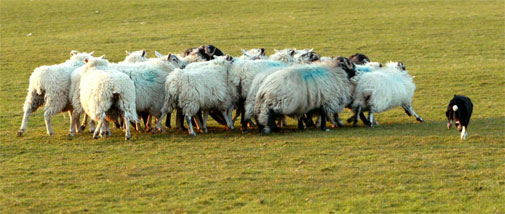
Craig Barnes is Professor of Leadership and Ministry at Pittsburgh Theological Seminary. In an article published in Christian Century in February, 2012, he says that he has learned a lot about being a pastor from the family’s sheepdog, Esau.[2] Being a herding dog, Esau watches what’s going on. If he sees someone straying from the group, Esau will circle and come up beside the errant animal and herd it back into the group. Back into safety. Protected from the wolf or other danger that exists when an animal gets separated from the herd. One of my good friends has a border collie- another herding breed. Misty has more energy than any other animal I’ve ever seen. Constantly alert and watching to make sure that no one gets separated from the others. That everyone is safe. And she’ll tear across the yard if she perceives a threat. She’s in full protection mode.
Sometimes we refer to clergy as “pastors” – same kind of metaphor. The one called by God to minister and to pastor to the flock. Craig Barnes suggests that we- each one of us- lay and ordained – perhaps ought to think of ourselves as sheepdogs. Jesus is the Good Shepherd, not us. After all, we are not the ones who can offer salvation or redemption. That is in God’s hands. But each one of us can be a sheepdog. We can be alert to those in our midst who are hurt- or who are straying from the comfort of the flock. We can offer a way back to community. We can reach out and offer food or drink or other types of support that may be helpful.
Who are the ministers of the church? our catechism asks. The answer: the laity, priests, bishops and deacons. Each of us can be a sheepdog. Each of us can be a companion to one who is hurting or who needs a helping hand. Each of us can make sure that those around us know that they are welcome. The sheepdog doesn’t act alone and for its own sake. The job of the sheepdog is to nudge the one straying back to the shepherd – the true leader of the flock. The sheepdog works with the shepherd. At the shepherd’s commands. The sheepdog knows, I think, that while it has a very specific and very important job to do, the real responsibility of caring for the flock belongs with the shepherd.
Thank goodness we are not called to be Jesus, the Good Shepherd. But we can sure be a good sheepdog.
Craig Barnes noted one additional thing that Esau does that we might do also. Esau, you see, each day as Esau and Craig take their morning walk finds something that excites him. And his tail begins to wag – and maybe he prances just a bit in joy and excitement. Esau has found something to celebrate. Each day is a new beginning. Each day there can be something for us to celebrate- it doesn’t have to be big. Each day we are called to rejoice- to renew our love for each other and this world that God has created. What will you celebrate this day? Amen.
[1][1] King James version, Psalm 23.
[2] M. Craig Barnes. “Faith Matters- The good sheepdog” (Christian Century, February 2012), 37.