
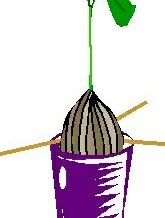
Does anyone know what this is?[1] How about this? That’s right: An avocado seed taken from the center of an avocado.
When I was little, growing up in Los Angeles, my aunt and uncle had an avocado tree in their backyard. When avocados were in season, we would pick them and make guacamole. Yum! But rather than throwing out the seed, we put toothpicks in the seed, put it on top of a glass of water and then watched it grow. We planted the seedling when roots had formed and filled up the glass- and there were shoots coming from the top as well as roots from the bottom. With good sunshine and water, that seed would grow to become an avocado tree- with new and more fruit for us to share as the years went by.
In our reading from Jeremiah, we overhear the prophet in conversation with the Lord. Jeremiah was, as were many of the prophets before him, reluctant to be a prophet. God persists, however and reminds Jeremiah that “Before I formed you in the womb, I knew you and before you were born I consecrated you” (Jer. 1:5). Jeremiah persists in his reluctance: “Ah, Lord God! Truly I do not know how to speak, for I am only a boy” (Jer. 1: 6). God is having none of this excuse: But the Lord said to me, “Do not say ‘I am only a boy’; for you shall go to all whom I send you, and you shall speak whatever I command you. Do not be afraid of them, for I am with you to deliver you” (Jer. 1: 7-8). Jeremiah finally said, ok, I give up. I will be your prophet, speaking your words to the people of God.
It was a rough time to be a prophet. Jeremiah lived at the hinge of time when Israel went from being an independent state to most of the people and particularly the leaders being taken in exile to Babylon. Some of the people went not to Babylon but to Egypt. The bottom line was that the people of God were scattered and were no longer, by and large, living in what they believed God had set aside as their homeland. The people of God had strayed far from their covenant with God: you shall be my people and I shall be your God (Lev. 26:12). The people had broken their covenant with God. The people had forgotten the words that were to be spoken each day: “Hear O Israel, The Lord is our God, the Lord alone. You shall love the Lord your God with all your heart and with all your soul and with all your might” (Det. 6:4-5). Words spoken aloud were no longer enough for the people to keep their part of the covenant with God. And so the people were scattered and sent into exile.
Even in exile, though, the Lord watches over the people and uses the prophets to beg the people to return to the covenant. “The days are surely coming” says the Lord, “When I will make a new covenant with the house of Israel and the house of Judah. It will not be like the covenant I made with their ancestors… I will put my law within them, and I will write it on their hearts; and I will be their God and they shall be my people” (Jer. 31: 31-32, 34). Once again, despite repeated disappointments and sorrows, God reaches out to God’s people. Come back. Come and be my people once again. This time will be different.
This time God’s Word will be written on our hearts – not without us but within us. Part and parcel of who we are as God’s people. So integral to whom we are that God’s Word is indistinguishable from how we live our lives – from who we are. Without God’s Word as the driving force and understanding of what it means to be a human being, we are not fully alive. We are not fully human.
The “Reason Rally” was held yesterday in Washington D.C. It was promoted as “a movement-wide event sponsored by the country’s major secular organizations. The intent is to unify, energize, and embolden secular people nationwide, while dispelling the negative opinions held by so much of American society… and having a damn good time doing it!”[2] I’m not quite sure what the negative opinions held by so much of American society are that have energized this organization- but I suspect part of the angst arises from our failures, as people of faith, to preach a Gospel of love and inclusion. A view of God that is forgiving and redemptive rather than judgmental. Whatever the results of the Reason Rally, I’m glad we live in a country where those who have different ideas and opinions are able to express them. If we are not willing to entertain the questions, we narrow our ability to see God in everything and in everyone, whether named as God or not. Hearing the questions and attempting to respond to them, as best as each of us is able, can serve to strengthen and deepen our our faith. If the Word of God is written on our hearts, when we respond to those questions we will respond in ways faithful and true to God. We can do no other.
Each of us has the opportunity, though, to live out the Gospel in what we do and how we do what we do. “Preach the Gospel at all times. Use words if necessary.” St. Francis of Assisi speaks much the same as the words of God spoken to the prophet Jeremiah. For me, being Episcopalian and somewhat congenitally challenged when it comes to traditionally defined evangelism, I find the words of St. Francis comforting. It can be easier for me to live the life of the Gospel than it can be to speak the Word of God. Who am I to say what the Word of God is to you? The answer is why not me – and why not you?
One of the characteristics we generally use to evaluate someone is whether they have “integrity” or whether they are “authentic.” Integrity has been defined as being whole, being honest, being true to expressed moral convictions. Being honorable. Authentic is similar in that someone or something is authentic when there is consistency – for a person, when there is consistency between what a person says and what a person does. I may not agree with the positions taken by that person – but I can respect them if there is consistency between what they say and what they do. I may not agree with them but if they have taken the time to think and to question what they believe and if they act consistently with the answers they have come to, I can respect them –and perhaps even learn from them as their questions and answers rub up against the answers I have come to. My faith can become stronger from being challenged. Having the Word of God written on your heart is the primary driver to being authentic and having integrity. If I believe the Word of God, then I must act in ways that support what I believe if I am not to tear myself up inside.
Paul puts the issue and the hope this way when speaking to the crowd gathered at the marketplace in Athens and speaking about the altar to an unknown God: “The God who made the world and everything in it, he who is Lord or heaven and earth, does not live in shrines made by human hands…. He made all nations to inhabit the whole earth… so that they would search for God and perhaps grope for him and find him – though indeed he is not far from each one of us. For ‘in him we live and move and have our being’” (Acts 17:24-28). The Word of God is to be written on the human heart so that the organ that makes life possible in a physical sense is also the organ that makes life meaningful in a spiritual sense.
Remember the avocado seed? If I place it in a glass of water without doing anything, it is likely to rot. A hard shell protects the inner core that is capable of life- but if the hard shell remains intact, it may never become all that is possible. If I insert toothpicks so that the seed is in the water but not drowned, the inner life can spring forth into a seedling and ultimately into a tree that itself bears fruit when the time is right.
The Word of the Lord is a bit like the toothpicks- it must reach into our hardened core in order to bear fruit. The toothpicks stuck into our core become the means by which we navigate the world. They hold us up – they give us structure- and in time are absorbed into the seed as it grows and develops until you can’t tell the seed from the toothpicks. We see this in nature in other places: the sapling planted close to the fence line until the point comes where the tree completely surrounds the fence line. God’s Word becomes so embedded in who we are that we can’t live without it. It nourishes us just like that avocado seedling planted that grows until it, too, bears fruit. A sweet fruit that nourishes our bodies with fiber and vitamins and becomes a symbol of God’s love for us.
Be like the avocado seed. Be pricked by God’s Word so that it becomes embedded in your very being. Then grow and bear fruit so that all who see you know that the Word of God lives in your heart. Amen.
[1] I am holding an avocado seed. Then, a whole avocado. Then toothpicks inserted into the avocado seed and then placing the avocado seed on top of a glass of water.
[2] http://reasonrally.org/about/ (March 24, 2012).