
We have laughed before about those words a priest hates to hear: “But, we’ve always done it this way.” Well, I have a new one for you today: It’s called “the let’s go back to Egypt Committee”[1] – whose focus is on what was the “golden age” – doesn’t matter if we disagree on whether it was 1950 or 1960 or 1970. The point is the focus of those on this committee is on the past and not on what God is doing right now and what God is calling us to do going forwards. When this parish was forming, it was at least in part because there was no other Episcopal Church in Greencastle, and so the Episcopal students at DePauw had no parish-away-from-home. Providing a church home to the Episcopal students attending DePauw was one of the items in the sacred bundle of this parish.
The concept of a sacred bundle comes to us from the Native American culture. It is something the shaman would take with him or her wherever the shaman went. It represented the values and the vision of the group. According to Patricia Deveraux, a member of the Blackfeet tribe in Alberta, “These are holy bundles given to us by the Creator to hold our people together… They’re the same as the relics from the Catholic Church. They are a demonstration of the holy spirit. They can heal people.” In the coming weeks, and as the Search Committee works with the parish around the Parish Profile, we’ll have a chance to consider what might be in our sacred bundle.
The image of a snake on a pole is a item that might be found in a sacred bundle. It is a symbol of God’s power to heal that comes to us out of Greek mythology as well as the Biblical stories. You might, at first, think of the snake on a pole as the caduceus, a symbol we in the United Stated have often associated with doctors and medicine. However, the caduceus has two snakes wound around a pole and usually the pole has wings. The single snake pole is the rod of Asclepius, again associated with medicine and healing.
You may remember the story from Exodus when Moses was petitioning the Pharaoh to let God’s people go. God told Moses to take his staff and lay it down – and when Moses did it became a snake. Up a staff, down a snake. Then the Pharaoh’s advisors got in the act and they put their staffs down and lo and behold they also became snakes. Up- a staff, down a snake. Finally, God said enough and the staff of Moses became a snake and ate the snakes of the Pharaoh’s advisors. God prevails.
The snake is one of the creatures created by God when all creatures were created. It, too, was among the creatures that Genesis tells us God named as “good” and indeed, “very good.” But along the way the snake becomes associated in our minds with the Devil, with Satan, with evil. And, in the beginning of the lesson from Numbers, the snake is poisonous and its bite kills people. God is frustrated with the “Let’s go back to Egypt” Committee and sends poisonous snakes to remind people that God is in control. God’s vision for the people – whom God has chosen over all other peoples of the world to be a light to all the nations- remain looking backwards towards Egypt. They resist God’s call to spread the message that there is one God and that God’s vision for all of humanity is one of peace and justice and mercy. The “let’s go back to Egypt” Committee wants things they way they were. They have conveniently forgotten what it was like to be a slave in Egypt. That supposed “golden age” wasn’t really golden – or at least not for all people. Murmuring once again, the people beset Moses. It’s your fault, Moses! Why did you lead us into the desert to die? And besides, we don’t like this food. This manna that saved our lives awhile ago, well, we’re tired of it. “Let’s go back to Egypt.”
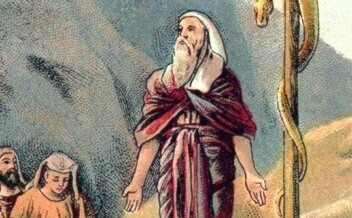
Moses does what I hope any clergy would do in the face of the murmuring, grumbling, finger-pointing and misery. He prays. Moses asks God, I’m sure, for wisdom and patience and for a solution. For a way to help the people see that “let’s go back to Egypt” is not an answer. That God has a plan – a vision for this people that means moving forward and not remaining rooted in the past. So God tells Moses to make a poisonous serpent and set it on a pole. And if anyone is bitten, all they need to do is look at the pole and the person will be healed. I can just imagine the laughter and scorn: “yea, right, you want me to look at a snake on a pole when it’s a snake that bit me in the first place? Are you nuts?” ”Yes”, Moses says, “what has been a bite because of your sin of refusing to trust in God, a bite that now threatens to end your life- yes, God can and does use the very same instrument to heal you and to help you learn to trust in God again.”
God didn’t take the snakes away – but he transformed an encounter with a snake – an encounter that happened because of sin and a refusal to trust in God – into one that redeemed the sinner and gave new life to the one bitten. The means of healing was to look on the pole – to look up because the pole was held high so all could see- nothing hidden here. Looking at the pole was available to all – no favorites and no prerequisites to healing. Look at the pole. See God’s power. Make no mistake. It is not the pole or the snake on the pole that made healing possible. It was trust and faith in God – the pole was merely a symbol. A symbol is something that points to a greater truth. It is not the truth but a signpost of what lies beyond the symbol.
For us, we do not have a snake. We have a cross. We have the crucifix of Good Friday. We have Jesus’ human body nailed to the cross. We also have the empty cross. The cross that reminds us of God’s great power to overcome the wickedness of the world. The cross that reminds us that Jesus was resurrected and then ascended into heaven – that the Son of Man was lifted up so that everyone who believes in him may not perish but have eternal life (John 3:16). Jesus hung on a cross that all who saw and who believe are given new life. The night of confusion and doubt and wandering is not forever for those who look and those who believe. As the psalmist reminds us, God has sent forth is word and healed them and saved them from the grave. (Ps. 107:20). God’s mercy endures forever (Ps. 107:1).
We are called, however, to do something after we receive God’s mercy. We are to give thanks and to tell of God’s acts with shouts of joy (Ps. 107: 21-22). We are not to stay rooted in the past. We are to live each day in the light of God’s love for us and for the world. Change is not always easy. For some, change is more difficult than for others. But a question to ask yourself: “if I don’t like change, how do I feel about becoming irrelevant”? The Rev. Dr. Chuck Robertson asked that question yesterday in his opening remarks at “Under One Roof.” He told of his time in England where he worked with parishes in the Church of England and with the people of Great Britain. In asking many people about their feelings about the Church, many of them said the church was irrelevant to their lives. “Why would I go?” was the response time and again. It wasn’t “why wouldn’t I go” but “why would I go.”
They had no snake on a bronze pole – they had no experience of Jesus on the cross, giving his life that we might have life- the church was, plain and simple, irrelevant to their lives. They saw the church, by and large, as a “Let’s go back to Egypt” committee. Too focused on the past. Too hidebound. Too much “but we’ve always done it this way.” They didn’t see God’s vision lived out by those who attended church. Duty. Obligation. No joy in what God has done for us through Jesus the Christ. No proclamation of the Word made flesh.
As we continue in our journey towards the call of a new rector, ask yourself what is it about St. Andrew’s that would be appealing to a newcomer? What part will you play in welcoming the stranger in our midst? Are you willing to trust in God and that there is a vision that appeals to those outside our doors and in which each of us has a part to play? Lent is the perfect time to ponder God’s call to us in this place and this time. God calls us to look forward with joy.
I hereby declare that the “let’s go back to Egypt” committee is disbanded. It is no more. We turn our eyes and our hearts forward proclaiming the good news of God revealed through Christ Jesus.
[1] From “Feasting on the Word” Year B, Vol. 2 for the Fourth Sunday in Lent. (Louisville: Westminster John Knox Press), David Bartlett and Barbara Brown Taylor, General Editors.